PEOPLES AND TERRITORIES OF THE ORINOCO
Piaroa / Huottuja / Wötjüja
The Piaroa, also known by self-designations including Huottuja, Wötjüja and De’áruwa, are an Indigenous people of the middle Orinoco region in Colombia and Venezuela. Their languages, gardens and river knowledge connect forest territories with contemporary community life.
Territory and Documented Presence
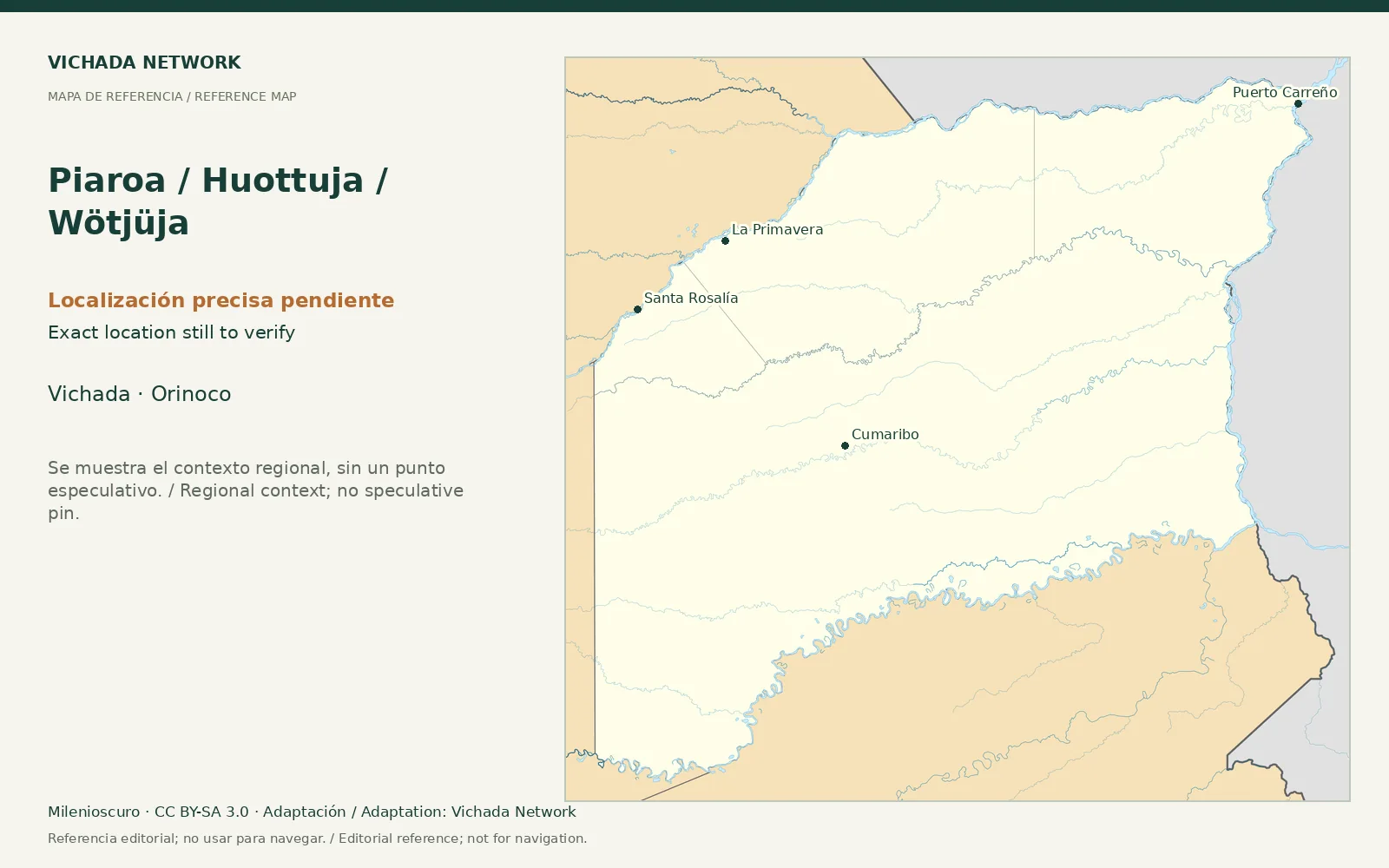
Piaroa territories extend across the middle Orinoco region, including the Sipapo and Cuao basins in Venezuela. Those rivers should not be confused with Colombian Vichada. In Colombia, Piaroa communities are among the six peoples of the Selva Matavén resguardo in Cumaribo. Matavén is a collective Indigenous territory with its own authorities.
Names, Language and Population
Spellings of self-designations vary between communities and publications. Piaroa belongs to the Sáliba–Piaroa language family. Use a person’s preferred name and ask which language they wish to use.
Colombia’s 2018 census recorded 1,127 Piaroa people. Venezuela’s 2011 census recorded 19,293 under Piaroa. These are national counts from different years, not a current combined population or a count of residents in Puerto Carreño.
Sources: British Council · About Piaroa People · DANE · Población indígena de Colombia, CNPV 2018 (2019) · INE Venezuela · Censo 2011, Empadronamiento de la población indígena (2015), cuadro 1.11
Autonomy, Cooperation and Social Life
The university resource Peaceful Societies summarizes ethnographic work, including Joanna Overing’s research, that emphasizes personal autonomy, cooperation and the cultivation of emotional restraint. Its description of egalitarian and peaceful ideals refers to particular social practices and research settings. It is not a claim that every Piaroa person has the same personality or experience.
The same resource describes changing livelihoods, market participation and work in professions such as teaching and nursing. Contemporary Piaroa lives include both community relationships and connections with towns.
Gardens, Food and Craft Knowledge
The British Council’s community-based work documents cassava cultivation, fishing and forest foods. In San Luis de Zama it explored materials for basketry. Work in La Urbana connected craft knowledge with food production. These are named community experiences rather than a description of every settlement.
Its food initiative brought elders and younger generations together around gardens, cooking techniques and recipes. Food sovereignty was an objective alongside cultural tourism. A visitor can therefore approach a meal or basket as the outcome of knowledge, materials and work, and ask the maker what they wish to explain.
Sources: British Council · About Piaroa People · British Council · Piaroa’s Crafts · British Council · Piaroa Traditional Cuisine
Worldviews and Living Knowledge
Published accounts discuss figures such as Wajari and Kwemoni and relationships among people, forest life and spiritual beings. These accounts belong to living traditions with different local histories. Hosts should choose whether to discuss spiritual matters.
A Matavén study records knowledge of fish contributed by Piaroa participants and three other peoples. It offers a concrete introduction to ecological knowledge without treating one study as an inventory of an entire culture.
Sources: British Council · About Piaroa People · Acta Amazonica · Investigación sobre conocimientos de peces en Matavén
Organization and Connections Today
FAO’s work in the Cataniapo basin documents community action planning in Venezuela. This is a useful contemporary perspective alongside ethnographic accounts. In Colombia, ACATISEMA provides a territorial point of reference for Matavén. Neither a research publication nor a foundation’s website substitutes for the decisions of a particular community.
Visits and Host Decisions
An agreed conversation about gardens, food preparation or river environments can be a starting point for learning. Ask hosts which subjects they want to explain, who will interpret and how contributors will be paid. Request separate permission for photographs, recordings and publication. Visits to Venezuela require their own access and immigration checks.
Visitor availability is unconfirmed. Before traveling, verify access and arrangements directly with the hosts.
Sources and Further Reading
- DANE · Población indígena de Colombia, CNPV 2018 (2019)
- INE Venezuela · Censo 2011, Empadronamiento de la población indígena (2015), cuadro 1.11
- British Council · About Piaroa People
- UNC Greensboro · Peaceful Societies: Piaroa
- British Council · Piaroa’s Crafts
- British Council · Piaroa Traditional Cuisine
- REDD+ Matavén · Comunidades indígenas / Indigenous communities
- Acta Amazonica · Investigación sobre conocimientos de peces en Matavén
- FAO Venezuela · Planes de acción comunitaria en el Cataniapo