PEOPLES AND TERRITORIES OF THE ORINOCO
Eñepá / Panare
The Eñepá, widely known as Panare, are an Indigenous people with documented territories in Venezuela’s Bolívar state. This profile also records a local account of Panare people living and working in Puerto Carreño, while keeping that observation distinct from census evidence.
Territory and Documented Presence
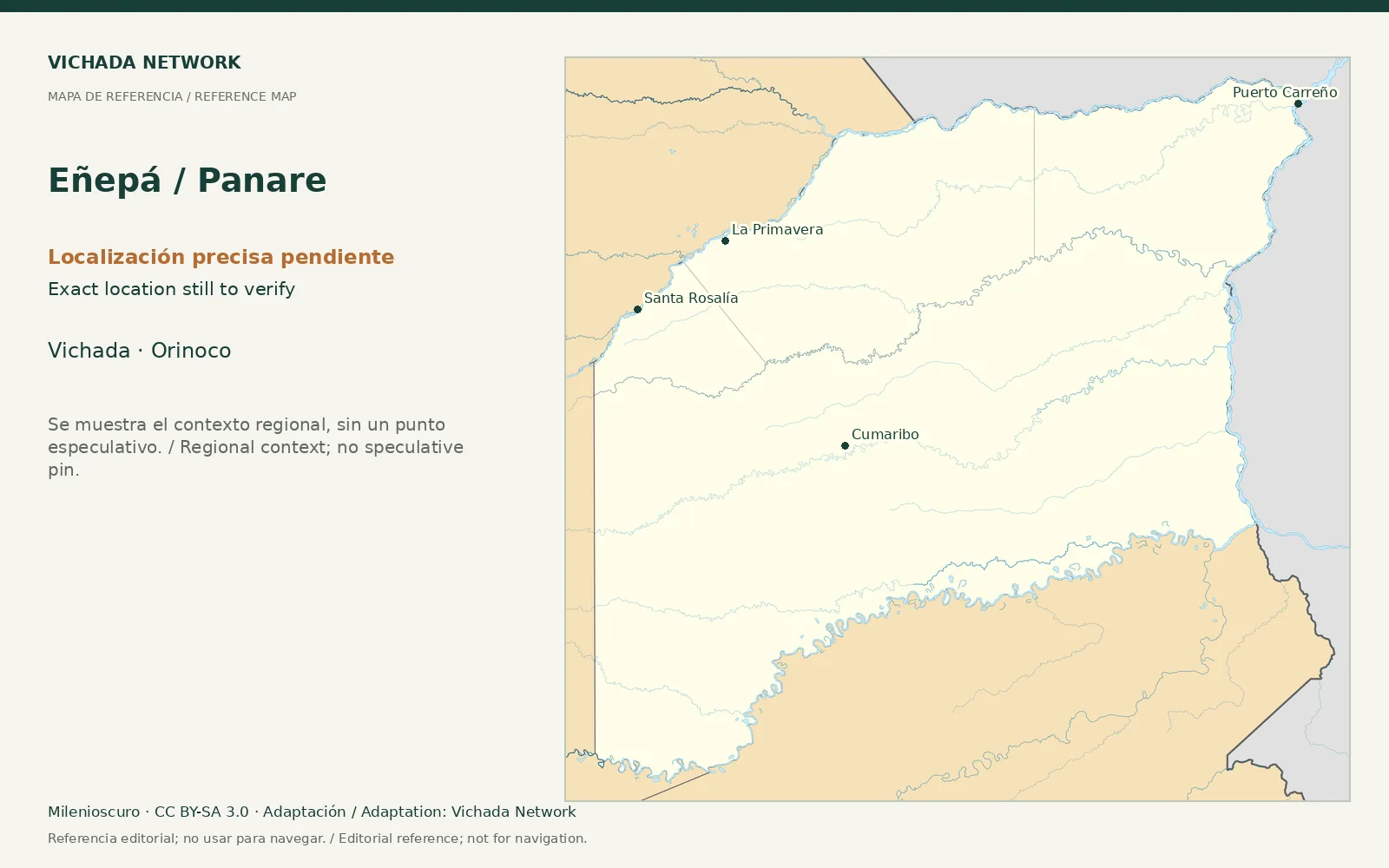
Alessandra Caputo-Jaffe’s research locates Eñepá communities in western Cedeño municipality, Bolívar, between the Cuchivero, Suapure, Caño Iguana and Orinoco river systems. These are Venezuelan territories. The research does not place them within Colombia’s Matavén resguardo or establish a visitor route from Puerto Carreño.
Self-Designation, Language and Population
Eñepá is a self-designation. Panare remains common in older publications and public usage. The language belongs to the Cariban family. Ask contributors which name and spelling they prefer for themselves and their community.
Venezuela’s 2011 census recorded 4,688 people under Eñepá/Panare. This is a dated national count. It is not a current estimate, a count for Puerto Carreño or evidence that the Panare are among that city’s five largest Indigenous populations.
Sources: Alessandra Caputo-Jaffe · Eñepá de La Batea, Chungará 49(3), 2017 · INE Venezuela · Censo 2011, Empadronamiento de la población indígena (2015), cuadro 1.11
A Documented Craft Tradition
Cambridge’s Museum of Archaeology and Anthropology holds a wapa, a shallow woven tray collected by Paul Henley in Colorado, Bolívar. The catalog records a purchase from an artisan in December 1980. Its plant-fiber construction, cane rim and patterned surface document a particular maker’s work within Eñepá material culture.
The record offers a concrete starting point for looking closely at construction, function and provenance. It should not be used as a present-day price guide. For contemporary work, ask the artisan how they describe the design and what attribution they want.
Sources: University of Cambridge, Museum of Archaeology and Anthropology · Wapa 1982.822
Livelihoods and Differences Between Communities
Caputo-Jaffe’s 2017 study describes cultivation, fishing, hunting and market connections. Based on visits to La Batea between 2014 and 2016, it examines how Christian practices and Eñepá worldviews coexist. Its comparison with other communities shows why one religious account should not be generalized to the entire people.
Future contributions to this page should identify the speaker, community and date, with permission. Topics might include present-day work, language teaching, craft production and connections across the Orinoco. We welcome corrections and accounts chosen by Eñepá contributors themselves.
Sources: Alessandra Caputo-Jaffe · Eñepá de La Batea, Chungará 49(3), 2017
Organization and Connections Today
Local account supplied by Col. David Wright, November 2026: Panare people are among those who come to Puerto Carreño to live and work. We have not established a municipal population count, a named local representative body or a community offering visits. This account is a starting point for further documentation with willing contributors.
Visits and Host Decisions
In Puerto Carreño, an agreed conversation with a willing Eñepá contributor can be a first step. For a proposed journey to a community in Venezuela, identify the community, its authority, an invitation and a viable route before making arrangements. Neither a museum object nor a historical ethnography confirms that a community receives tourists.
Visitor availability is unconfirmed. Before traveling, verify access and arrangements directly with the hosts.