PEOPLES AND TERRITORIES OF THE ORINOCO
Piapoco
The Piapoco are an Arawak-speaking Indigenous people with communities in Colombia and Venezuela. Their regional history connects rivers, cultivation, craft knowledge and collective territorial organization.
Territory and Documented Presence
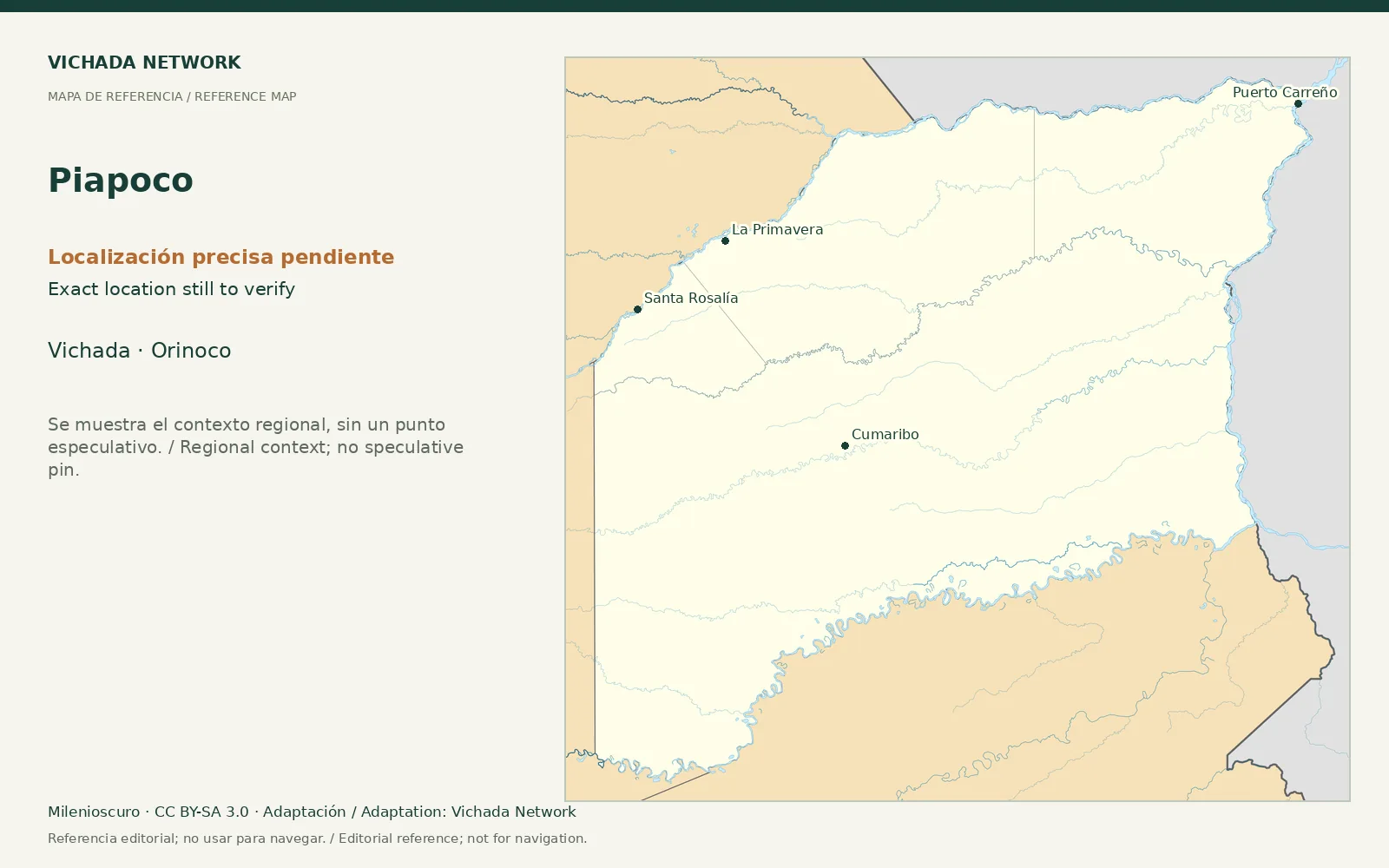
ICANH documents Piapoco presence in Vichada and Guainía in Colombia and in Bolívar and Amazonas in Venezuela. In Vichada, Matavén identifies the Piapoco among its six peoples. National Land Agency Agreement 441 establishes Shuiroog-Rt Piedra Veredal in Cumaribo for Puinave and Piapoco families. A shared territory does not make those peoples interchangeable.
Names, Language and Population
Piapoco appears alongside names such as Dzase and Dejá in ICANH’s collection. The language belongs to the Arawak family. Shared linguistic ancestry with neighboring peoples does not mean that their languages, authorities or identities are the same.
Colombia’s 2018 census recorded 14,661 Piapoco people nationwide. Venezuela’s 2011 census recorded 3,714 under Piapoko/Chase. These figures have different dates and administrative contexts. Neither measures the number of Piapoco people currently living or working in Puerto Carreño.
Sources: ICANH · Pueblo Piapoco · DANE · Población indígena de Colombia, CNPV 2018 (2019) · INE Venezuela · Censo 2011, Empadronamiento de la población indígena (2015), cuadro 1.11
River Life, Cultivation and Ecological Knowledge
ONIC’s profile describes cultivation and the use of river and forest resources, alongside changes in work and settlement. These activities depend on a particular place and its seasonal conditions. They should be understood through a community’s own account rather than as a fixed lifestyle.
A scientific study in Matavén documents Piapoco contributions to knowledge about fish, together with Piaroa, Puinave and Sikuani participants. It illustrates the value of local classifications and observations for understanding aquatic environments. A useful conversation can start with how fish and habitats are named, if contributors wish to share that knowledge.
Sources: ONIC · Piapoco (2016) · Acta Amazonica · Investigación sobre conocimientos de peces en Matavén
Crafts, History and Contemporary Connections
The 2020 Idä–Barrio Mateo report places Piapoco participants within a craft initiative linked to Puerto Carreño and Caño Guaripá. It documents moriche-fiber work and woodcarving among a group that included several peoples. The initiative is evidence of local cultural and economic connections, not confirmation of a currently bookable workshop.
ICANH also describes the effects of rubber extraction and the animal-skin trade on movement and community life. Historical collections need that context: an object preserves one moment and relationship, while the people concerned continue to make their own social, cultural and political choices.
Sources: Artesanías de Colombia · Diagnóstico Idä–Barrio Mateo, Caño Guaripá (2020) · ICANH · Pueblo Piapoco
Organization and Connections Today
ICANH describes captains, governors and spiritual specialists among the figures involved in community organization. The appropriate representative depends on the community and the subject. For Matavén, begin with the territorial organization and sector authorities. A museum can provide historical context, while community members are the source for their lives and priorities today.
Visits and Host Decisions
A host-led conversation about gardening, navigation, fishing or crafts can provide an introduction if a community chooses to offer it. Ask who made an object and whether its story can be recorded. Pay makers and interpreters directly under an agreed arrangement. Do not assume that a public description of a resguardo gives permission to enter.
Visitor availability is unconfirmed. Before traveling, verify access and arrangements directly with the hosts.
Sources and Further Reading
- DANE · Población indígena de Colombia, CNPV 2018 (2019)
- INE Venezuela · Censo 2011, Empadronamiento de la población indígena (2015), cuadro 1.11
- ICANH · Pueblo Piapoco
- ONIC · Piapoco (2016)
- Artesanías de Colombia · Diagnóstico Idä–Barrio Mateo, Caño Guaripá (2020)
- Acta Amazonica · Investigación sobre conocimientos de peces en Matavén
- REDD+ Matavén · Comunidades indígenas / Indigenous communities
- Agencia Nacional de Tierras · Acuerdo 441, Shuiroog-Rt Piedra Veredal
- ICOM Venezuela · Museo Etnológico de Amazonas