PEOPLES AND TERRITORIES OF THE ORINOCO
Puinave / Piunave
The Puinave are an Indigenous people associated with the rivers and forests of eastern Colombia and neighboring Venezuela. Their presence in Vichada forms part of a wider regional geography centered particularly on Guainía.
Territory and Documented Presence
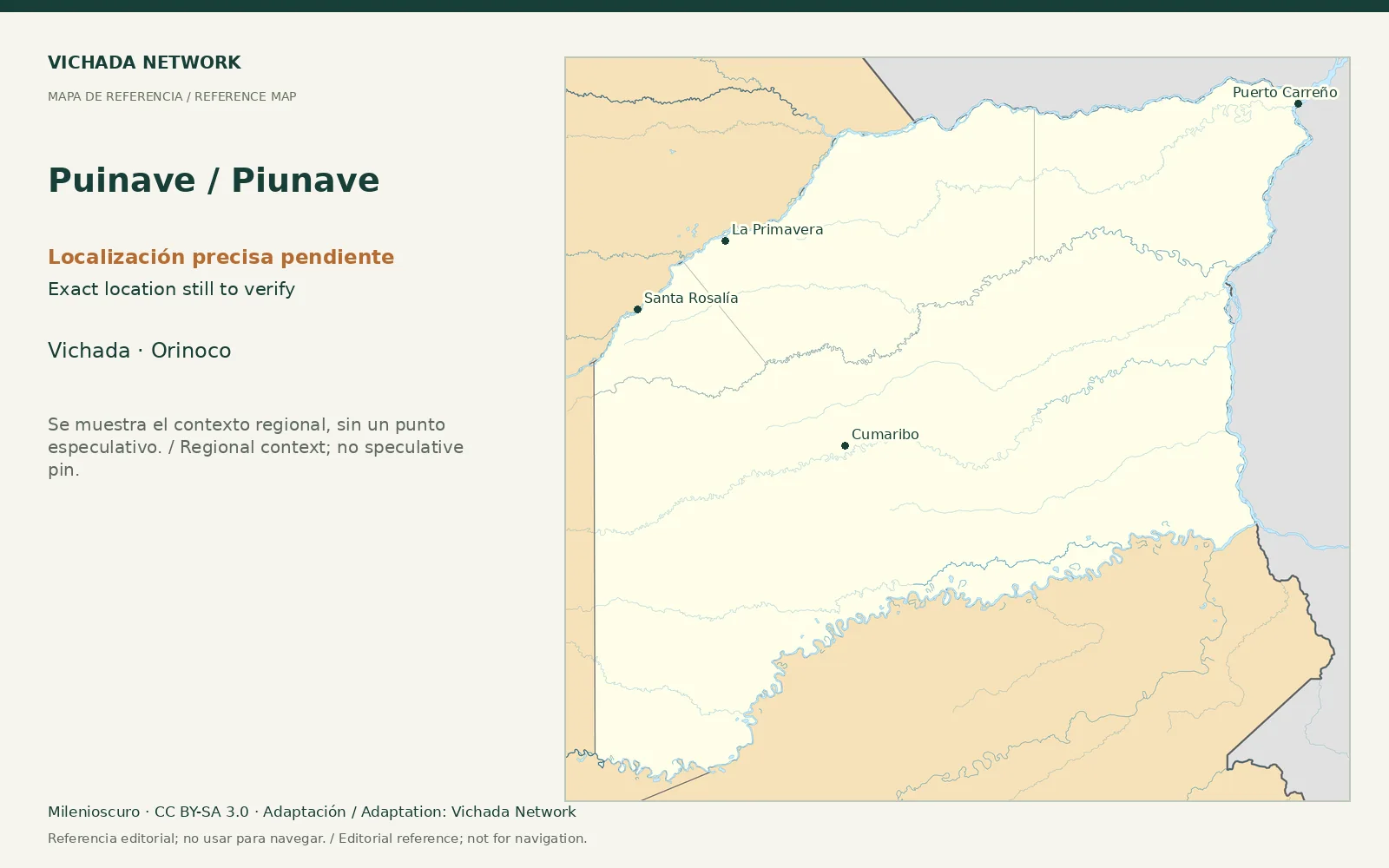
British Council materials locate Puinave communities mainly along the Inírida and Guaviare rivers, with a presence in Guainía, Guaviare and Vichada. In Cumaribo, the Puinave are among the six peoples of Selva Matavén. The National Land Agency also documents Shuiroog-Rt Piedra Veredal, a collective territory shared with Piapoco families. These references should be distinguished from reserves and communities in Guainía.
Names, Language and Population
Puinave appears with several spellings and self-designations in linguistic records. Glottolog treats the language as an isolate: proposed relationships with other language families remain unproven. Older sources sometimes place it in a broad “Makú-Puinave” category, which should not be repeated as settled classification.
Colombia’s 2018 census recorded 8,984 Puinave people. Venezuela’s 2011 census recorded 1,716. Both are national counts from specific years, not a contemporary total or a count of residents in Puerto Carreño.
Sources: Glottolog · Puinave, puin1248 · DANE · Población indígena de Colombia, CNPV 2018 (2019) · INE Venezuela · Censo 2011, Empadronamiento de la población indígena (2015), cuadro 1.11
Food, Water and Forest Knowledge
The British Council’s account describes fishing, cassava gardens and forest-fruit gathering. It also records the influence of twentieth-century missions on settlements and social life. These processes produced changes, and accounts of one community should not be used to assign identical beliefs or practices to all Puinave people.
In Matavén, a scientific study includes Puinave knowledge of fish alongside contributions from Piapoco, Piaroa and Sikuani participants. This provides a specific example of ecological knowledge grounded in local waters. Questions about seasons, names and habitats should be guided by what participants want to share.
Sources: British Council · About Puinave People · Acta Amazonica · Investigación sobre conocimientos de peces en Matavén
Crafts and Community Enterprise
Work with Bachaco-Buenavista communities documented pottery, woodcarving and plant-fiber textiles. The British Council describes artisans organizing to improve production and trade their work more independently. The source concerns those participating communities, rather than a uniform craft tradition across all Puinave territories.
A purchase can also be an opportunity to ask about a maker’s process, the source of a material and the use of an object. Ask whether a photograph or explanation is welcome. Record the maker’s preferred credit when permission is given, and avoid publishing restricted knowledge simply because an object is for sale.
Sources: British Council · Puinave Crafts
Organization and Connections Today
Community organization and representation depend on the territory. In Matavén, consult ACATISEMA and the relevant sector’s authorities. Research with Puinave participants can introduce particular knowledge, but it does not authorize someone else to speak for a whole people. The Amazonas Ethnological Museum in Puerto Ayacucho offers another regional historical resource.
Visits and Host Decisions
The British Council has described fishing and birdwatching as possibilities within community-led tourism initiatives. That publication does not establish current availability. Ask which activities hosts actually offer, who accompanies visitors and where income goes. Agree on access, transport and interpretation before leaving Puerto Carreño, especially when the destination lies in another department or country.
Visitor availability is unconfirmed. Before traveling, verify access and arrangements directly with the hosts.
Sources and Further Reading
- DANE · Población indígena de Colombia, CNPV 2018 (2019)
- INE Venezuela · Censo 2011, Empadronamiento de la población indígena (2015), cuadro 1.11
- British Council · About Puinave People
- Glottolog · Puinave, puin1248
- British Council · Puinave Crafts
- British Council · Puinave Ecotourism
- REDD+ Matavén · Comunidades indígenas / Indigenous communities
- Agencia Nacional de Tierras · Acuerdo 441, Shuiroog-Rt Piedra Veredal
- Acta Amazonica · Investigación sobre conocimientos de peces en Matavén
- ICOM Venezuela · Museo Etnológico de Amazonas